Research
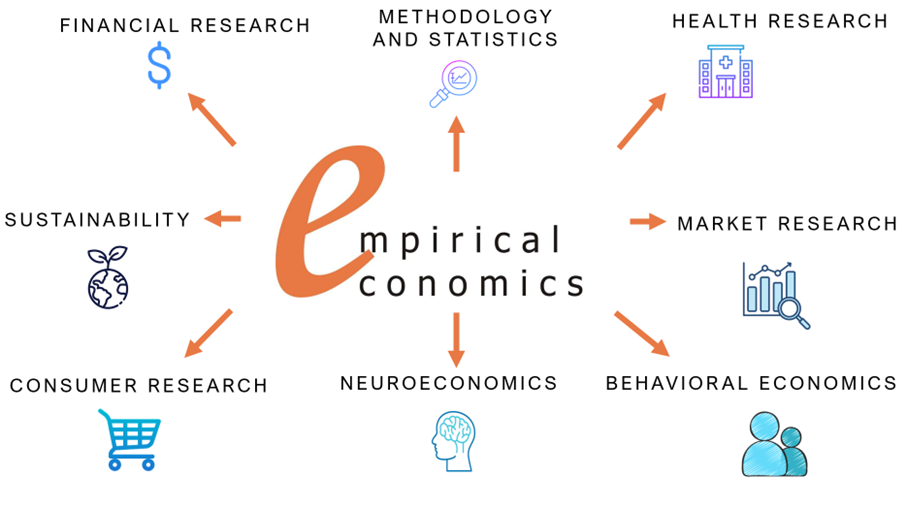
Our research areas are broad and cover the following fields:
- Financial research
- Market research
- Health research
- Neuroeconomics
- Consumer research
- Sustainability
- Behavioral economics
- Methodology and statistics
The scientific work of our team is based on the use of empirical, experimental and quantitative methods. Through its diverse research fields, the team works in an interdisciplinary manner and addresses a wide range of research questions. Below is an excerpt of some of the research questions that are central to our work:
- What are the economic impacts of mental illness?
- How do people allocate losses compared to gains?
- What influence do social norms have on distributional decisions?
- Which factors influence consumer decisions regarding sustainable products and services?
- Which factors promote cooperation?
- Does the statistical power and/or predictive performance of correlation-based methods change?
- How do DeFi markets function in detail?
Selected current research projects
Sustainable Consumer Behavior
Extending product lifetimes through repair is a central element of the circular economy. It reduces the number of new devices that need to be produced, lowers the amount of electronic waste, and conserves finite raw materials. Although a large share of consumers state that they would prefer to repair defective devices rather than replace them, actual repair rates remain low. An initial study has shown that uncertainty about costs, the probability of repair success, and post-repair functionality plays a key role in why consumers often decide against repair and in favor of purchasing a new product. Building on this, the project shifts the focus from the consumer perspective to the entire ecosystem. Measures aimed at increasing repair rates, such as repair subsidies, the right to repair, or improved consumer information, affect not only consumers but also manufacturers, repair businesses, and society.
Further work in the field of sustainable consumer behavior focuses on the purchase of green electricity. A more transparent breakdown of renewable energy sources in electricity labeling increases willingness to pay, and the effect of traffic-light colors on CO₂ labels depends strongly on individual decision-making style and may even reverse among individuals with a stronger rational orientation.
Bengart, P., & Vogt, B. (2025). The impact of uncertainty in repair service attributes on consumer preferences: Insights from a dual‐response choice experiment. Journal of Industrial Ecology, 29(4), 1414–1425.
Bengart, P., & Vogt, B. (2023). Effects and interactions of labels’ color scheme and the individual difference variable lay rationalism on pro-environmental choices. Journal of Environmental Psychology, 87, 101998.
Bengart, P., & Vogt, B. (2021). Fuel mix disclosure in Germany—The effect of more transparent information on consumer preferences for renewable energy. Energy Policy, 150, 112120.
Practical Arbitrage
The research project examines practical arbitrage strategies between decentralized and centralized cryptocurrency exchanges. The central question is to what extent price differences between DEX and CEX markets can be exploited realistically and profitably when operational trading costs, slippage, liquidity constraints, transaction fees, execution risks, and competition among arbitrageurs are taken into account. In contrast to existing studies, which are predominantly based on backtesting, the project analyzes realized arbitrage trades generated by a self-developed high-frequency trading system.
The project develops an algorithmic trading system for two-point and triangular arbitrage, implemented on different blockchains and incorporating both AMM-based DEX structures and CEX limit order books. Particular emphasis is placed on the mathematical modeling of slippage, cost functions, mempool data, and transaction sequences, as these factors have a substantial impact on actual profitability.
The empirical analysis shows that arbitrage in fragmented crypto markets can be profitable, but is by no means risk-free. The project thus contributes to the understanding of market efficiency, liquidity fragmentation, and the limits of practical arbitrage at the intersection of DeFi and CeFi.
Schwertfeger, L., & Vogt, B. (2026). Arbitrage trading between decentral and central cryptocurrency exchanges. Journal of Banking & Finance, 188, 107721. https://doi.org/10.1016/j.jbankfin.2026.107721
Schwertfeger, L., & Vogt, B. Arbitrage trading between decentral and central cryptocurrency exchanges. Available at SSRN 5055292.
Schwertfeger, L., & Vogt, B. (2026). Practical Strategies for DeFi Efficiency: A Technical Framework for Arbitrage, Liquid Staking Redemption, and Yield Farming.
Schwertfeger, L., & Vogt, B. (2025, July). A Guide to Decentralized High-Frequency Trading Infrastructure. In The International Conference on Mathematical Research for Blockchain Economy (pp. 273–284). Cham: Springer Nature Switzerland.
MentalBurden – Economic Impacts of Mental Health

In cooperation with Prof. Dr. Apfelbacher from ISMG, the following studies are being conducted:
Mental illnesses are among the most common causes of work incapacity in Germany. While direct treatment costs are well documented, little is known about the broader economic consequences for those affected. The project investigates how depression and anxiety disorders affect work productivity, income, consumption behavior, saving decisions, and wealth accumulation. The research focuses on Saxony-Anhalt, a region with an above-average burden of disease and, at the same time, an undersupply of therapeutic care. Using a large-scale survey conducted via the DigiHero pool, health and economic data are combined in order to quantify the actual costs of mental illness from the perspective of those affected.
Further information is available at: https://forschung-sachsen-anhalt.de/project/mentalburden-individuelle-last-gesellschaftliche-28591
A list of completed research projects can be found here.